Uncertain about a symptom? Let’s trace the signals together.

Get a clear direction when your health feels uncertain.

An advanced evaluation engine built to map health possibilities using strict, clinical logic flows. Thorough, entirely private, and free from the panic of generic search results.

PDF health report icon

Download an instant 1-page PDF for your next doctor visit.

Start your private symptom assessment
(Your 1-page summary in about 5 minutes)
Map your symptoms with strict clinical logic — not generic search results.
Entirely private. No email required to begin.

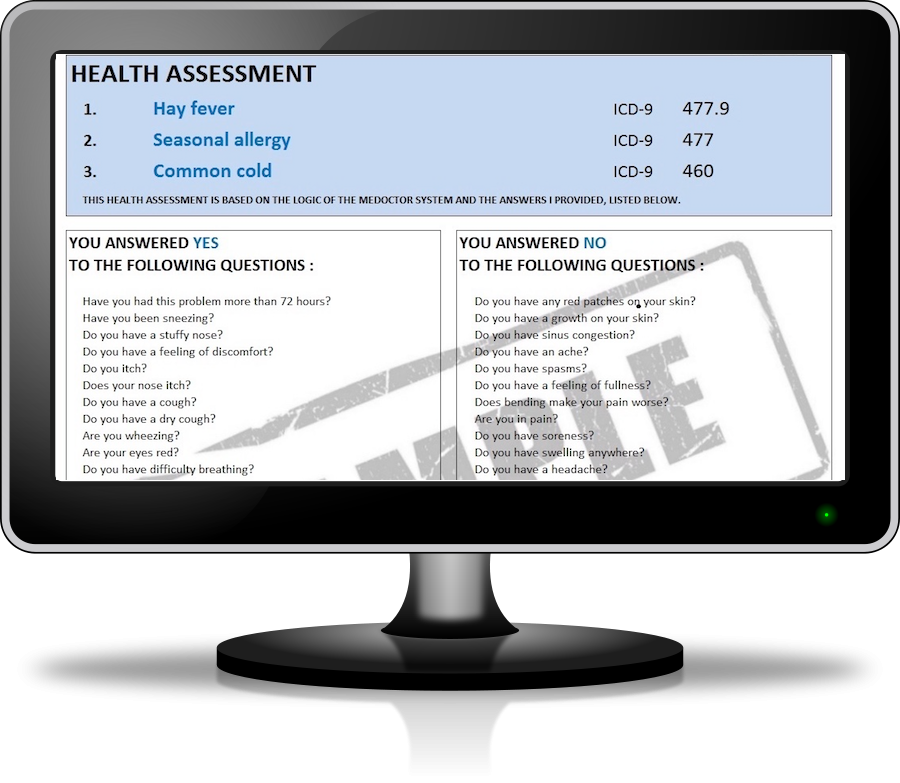
Here is an Example of what You Will See. It's Free!

Frequently Asked Questions

What is a Symptom Checker?

A guided way to map symptoms you feel—not signs a clinician measures—using structured clinical logic instead of generic search results.

Early-Detector.ai walks you through symptoms only you can perceive (pain, dizziness, anxiety, and more) and produces a differential view of possible conditions. It is powered by a patented assessment engine (US Patent #7,149,756 A; EPO Patent #EP 1284639 B1). It supports your preparation—it does not replace an in-person medical exam.

Our Mission is to Help You

We help you understand possible health directions privately, then bring a clear one-page summary to your clinician.

Early-Detector.ai is built to reduce guesswork before and during your doctor visit. From minor concerns to more serious possibilities, the interview organizes what you feel so you can discuss it calmly with a healthcare professional who can confirm diagnosis and treatment.

Your Health Challenge is Our Challenge

When cost, access, or stress block care, organizing your symptoms early can make the next conversation more productive.

Many people struggle to afford care or recall every symptom under pressure. Early-Detector.ai gives you a private, structured assessment and printable summary so you arrive prepared—not overwhelmed.

Your Health Care Solution

Free, 24/7 logic-based assessments with an instant PDF you can hand to your practitioner.

Access actionable health information when it matters—from any connected device. Early-Detector.ai uses a sophisticated patented algorithm to map thousands of symptoms and hundreds of conditions into a concise report for your next appointment.

Privacy Commitment

No email required to start. Your session data is handled with healthcare-grade privacy practices.

We protect confidential information collected during your assessment. The anonymous flow does not require identifying yourself beyond what you choose to share. Account credentials and interview data are treated as sensitive and access-controlled.

When Should I Use Early-Detector.ai?

Use it to understand symptoms, explore possible conditions, and prepare for conversations with healthcare professionals.

Early-Detector.ai is designed to help you better understand symptoms and prepare for conversations with healthcare professionals. It can be useful for identifying possible conditions, learning about health concerns, and deciding whether medical attention may be needed. Early-Detector.ai does not replace a licensed physician or emergency care.

How many symptoms and diseases does Early-Detector cover?

Early-Detector.ai covers 4,500 symptoms and 840 diseases in its core medical knowledge base.

When counting male and female specific variations separately, coverage expands to 4,900 symptoms and 950 diseases.

This makes Early-Detector the largest symptom checker built specifically for the end user — 3x more conditions than Symptomate, wider than Buoy, MEDiktor and Clearstep (120 protocols), and second only to ADA Health for overall breadth.

How do you count 4,500 symptoms? Is that inflated?

No. We count distinct medical concepts mapped to ICD-10 and our clinical validation library.

“Headache” is 1 symptom; “Headache in the morning” is a modifier, not a new symptom. Our 4,500 are 4,500 unique clinical presentations validated by our medical board. Cross-gender expansion to 4,900 simply counts e.g. “pelvic pain — male” and “pelvic pain — female” separately, because triage is different.

Does Early-Detector give a diagnosis?

No. Early-Detector is a pre-diagnosis and triage support tool.

It provides a list of possible conditions and care recommendations to help guide your decision, but it does not provide a medical diagnosis and should not replace the judgment of a licensed healthcare practitioner. Always consult your doctor.

How accurate is the engine?

Our adaptive interview asks 30–70 questions (vs 10–20 for most checkers) to reach higher precision.

An independent validation study is in progress for our CE Class IIa submission.

Is Early-Detector a certified medical device?

Early-Detector.ai is currently in the process of CE marking as a Class IIa medical device under EU MDR.

Until certification is completed, it is provided as a clinical decision support and patient education tool. Our quality management system is built according to ISO 13485 requirements.

How many questions does a patient have to answer?

Our standard interview is 3–12 minutes with 30–70 dynamic questions, depending on complexity.

Simple cases finish in ~3 minutes / 30 questions. Complex cases go up to 70 questions to differentiate 840 conditions. Patients can stop anytime and still receive a report.

Do you provide a printout or report for the doctor?

Yes. At the end of every interview, the patient receives a downloadable PDF report.

The report includes reported symptoms, risk factors, red flags, probable conditions with explanations, recommended level of care, and suggested questions to ask the doctor. The report can be emailed, printed, or automatically injected into your practice management system.

How is this different from ADA, Symptomate or Buoy?

Consumer apps like ADA and Symptomate are built for patients at home. Early-Detector is built for your clinic website.

  • Distribution: 1-line <script> installs on WordPress, Wix, or equivalent in 2 minutes. No IT team needed.
  • Depth: 30–70 questions vs 10–20, to generate real pre-consultation data, not just “Go to ER”.
  • Coverage: 840 diseases / 4,500 symptoms vs 600/1,500 for Symptomate and 120 protocols for Clearstep.

What about data privacy and HIPAA / GDPR?

All data is encrypted in transit and at rest, stored in EU data centers. Early-Detector is GDPR compliant and designed to be HIPAA compliant for US partners.

We act as a data processor for the clinic. We do not sell patient data. Anonymized, consented data may be used to improve population health analytics.

What happens with male vs female specific conditions?

Our engine automatically adapts. Selecting “female, 32” assesses against 950 diseases including female-specific and pregnancy-related presentations.

The same applies for male. This cross-gender logic is why our total expands from 840 to 950 conditions and 4,500 to 4,900 symptoms.

How widely is Early-Detector used?

300’000+ patients across 60+ countries on clinic and partner websites worldwide.

Early-Detector is currently installed on a certain number of websites and has been used by 300’000+ patients across 60+ countries.

How long does a typical session last?

The average session lasts 4 minutes and 50 seconds — most users finish in under 5 minutes.

The average session lasts 4 minutes and 50 seconds. Most users complete the interview in under 5 minutes while still receiving a full clinical-depth assessment.

How many questions does the average interview contain?

The average interview contains 48 dynamic questions, typically ranging from 30–70 overall.

The average interview contains 48 dynamic questions. The system adapts in real time — simpler cases finish faster, more complex presentations receive deeper questioning (typically 30–70 questions overall).

What is the completion rate of an Early-Detector.ai health assessment?

78% of users complete the full assessment and receive their 1-page PDF report.

78% of users complete the full assessment and receive their 1-page PDF report. This high completion rate reflects the balanced design: thorough enough for clinical usefulness, short enough to keep patients engaged.

How large is the medical knowledge base in practice?

10+ million symptoms and 600’000+ conditions analyzed across real patient sessions.

To date, the engine has analyzed 10+ million symptoms and 600’000+ conditions across real patient sessions, continuously refining its clinical logic.

About Us